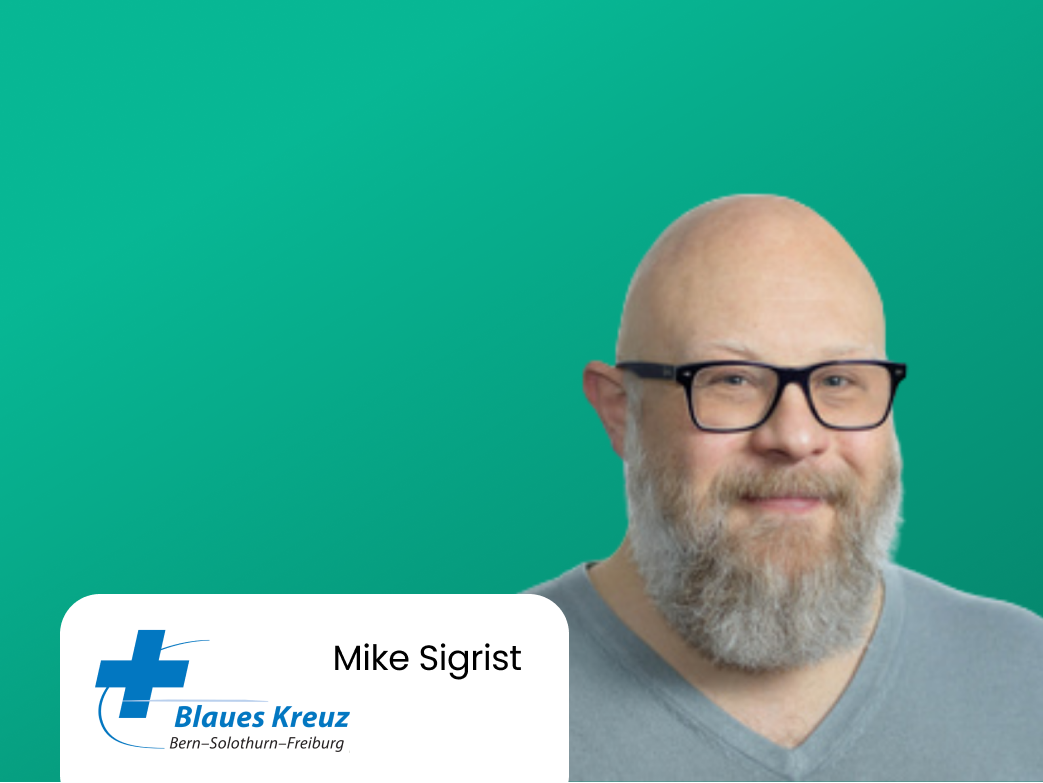
Documentation in Addiction Counselling: How AI Is Changing Everyday Work at the Blaues Kreuz

<callout-box-left>• <b>Time savings: </b>Around <b>a third less documentation time</b> with notes ready directly after the session<br/> • <b>Up to date: </b>No more postponed notes<br/> • <b>Quality: </b>Consistent and professionally sound <br/>• <b>Structure & clarity: </b>Übersichtliche, direkt nutzbare Notizen<br/> • <b>Language: </b>Understands dialect and mixed-language situations<br/><callout-box-left>
Blaues Kreuz Bern-Solothurn-Freiburg
Documentation takes time, but it is indispensable. At the Blaues Kreuz Bern-Solothurn-Freiburg, this long meant a heavy workload and little consistency within the team. Today, things look different.
The Blaues Kreuz BE-SO-FR is a specialist organisation for addiction issues, with a focus on alcohol, operating in the cantons of Bern, Solothurn and Fribourg. Around 90 employees work at various locations in prevention, counselling and integration. In counselling and therapy, the organisation offers low-threshold, wide-ranging services – from individual, couples and family sessions to brief counselling by phone, email or online, as well as support before and after inpatient stays. Family members and children from families affected by addiction are also specifically included. The goal is always the same: to support people on their path to greater self-determination and quality of life.
Mike Sigrist is Deputy Managing Director and Head of Counselling. He has worked at the organisation for around 25 years and has seen the development of counselling work at first hand. Alongside his management role, he is still actively involved in counselling himself, keeping him close to the everyday reality of employees and clients. His role covers not only professional leadership but also the further development of the department. For him, this deliberately includes exploring and introducing new approaches and technical solutions that make the team’s work easier and support it in meaningful ways.
How PlaynVoice makes documentation smarter
For many years, documentation was done the traditional way: handwritten notes during or after sessions, which were then transferred into the client management system. Each person in the team worked with their own system, which led to differences in the quality and structure of documentation. At the same time, the effort was high, as notes first had to be written by hand and then transferred. As a result, documentation was often postponed and sometimes remained unfinished for long periods. Against this backdrop, the goal was not only efficiency but also greater consistency within the team.At the same time, Mike had long been interested in technical solutions, for example by testing digital note-taking tools or handwriting recognition. None of these options, however, was truly convincing.
Why PlaynVoice?
Mike’s aim was to find solutions that would both make everyday work easier and allow for a degree of standardisation.PlaynVoice was first tested on a small scale. The deciding factor was not only the time savings, but above all the combination of immediately available documentation and a consistent structure. The feedback was quickly clear enough to take the next step: rolling it out across the entire team.
„I’m always looking at what helps us move forward professionally and technically, and how we can make our work easier."
Mike Sigrist
At the same time, there was room for individual use: employees can choose how detailed their notes should be and how they integrate the tool into their way of working.
Everyday use
Today, PlaynVoice is used as standard by the whole team, provided clients consent. Notes are created directly after the session, and usually a first version is already available by the time the client leaves. It is then transferred into the client system and supplemented as needed. In the past, this was often done much later.
„For me, it’s an important time saver, because there’s already something in writing electronically that I can build my documentation on."
Mike Sigrist
The key point: PlaynVoice provides a basis. Professional assessment and responsibility remain entirely with the staff.
A typical workflow looks like this:
- Start recording
- Conduct the session
- Automatic summary immediately afterwards
- Read through, adjust, add to it
- Transfer into the client system
What has changed
1. Documentation happens immediately
Probably the most visible effect: notes no longer pile up. Documentation takes place directly after the session and is therefore up to date and reliable. What used to remain open for days or even weeks is now done right away.
„I sometimes had notes open for two weeks. Now I’m practically always up to date.“
Mike Sigrist
2. Much less effort when writing
The real relief lies not in the work disappearing, but in getting started. Instead of starting from scratch, employees can build on an existing basis, check it, adjust it and add to it. For employees who find writing time-consuming in particular, this makes a big difference.
„I’d say we save about a third of our previous documentation time."
Mike Sigrist
This doesn’t make documentation superfluous, but it does make it much more manageable.
3. Quality of notes
The requirements for documentation are clearly defined: traceable, professionally accurate and transparent towards clients. In terms of completeness and traceability in particular, quality is experienced as more consistent than before. At the same time, it remains clear that final responsibility lies with the professionals.
4. Strong with language
A major advantage shows up in everyday work: PlaynVoice handles linguistic diversity well. Swiss German, various dialects, Standard German and even broken German are processed reliably. In a heterogeneous counselling context with people from different linguistic backgrounds, this is crucial.
5. More time for the actual work
More time here does not mean more revenue, at least not in the traditional sense. In the Blaues Kreuz setting, the estimated time savings of around a third do not lead to more billable clients, as the organisation operates on a global budget.
Instead, it frees up space for other services:
- More time for various services such as phone, email, groups or talks
- Better use of existing resources
- More focus on substantive work rather than documentation
The organisation’s perspective
PlaynVoice is clearly understood as support, not as a replacement.
„It doesn’t do everything for you – it’s not supposed to, and it mustn’t.“
Mike Sigrist
The focus remains on the relationship and the work with clients. Documentation continues to be seen as a necessary part of the job, but not as its core.Especially in relation to the time saved and the reduced effort, the value for money is seen as right.
„The effort and the return have to add up – and here, they really do add up very well for us.“
Mike Sigrist
Conclusion from Practice
PlaynVoice is not seen as a “miracle solution”, but as one that works in everyday practice and offers pragmatic support. It takes over a large part of the documentation work without replacing professional responsibility. That is exactly where its added value lies. Or, to put it more directly:
„Writing notes isn’t the reason we do this job.“
Mike Sigrist
In concrete terms, this means today:
Documentation is up to date.
The writing effort is significantly reduced.
Quality is improving.
And above all, there is more room for substantive work – whether in conversations with clients, in additional services or in other professional tasks.
<callout-box>PlaynVoice makes documentation efficient and time-saving. Book a demo now.<callout-box>
Specialised in mental health
Download the Case Study as a PDF
Weitere Artikel
Willst du es selbst ausprobieren?
Bei einem kurzen Gespräch erklären wir dir weitere Details und geben dir Zugang zu PlaynVoice. “Probiere got über studiere.”